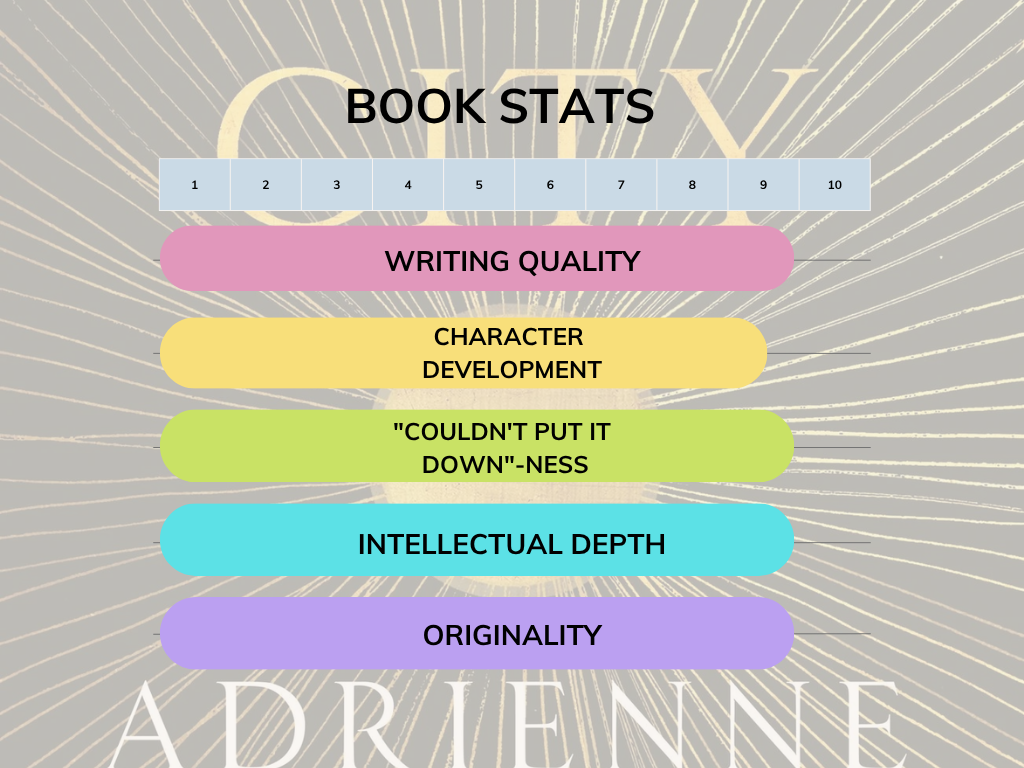

Fallen City by Adrienne Young combines political intrigue, subtle fantasy, and deeply compelling character dynamics into an addictive first installment that leaves readers desperate for more.
Adrienne Young has always excelled at writing compelling characters, and Fallen City may be one of her strongest examples yet. While the novel features plenty of political intrigue, divine magic, and large-scale conflict, its greatest strength lies in its characters and the relationships that drive the story forward.
This is a book that immediately hooked me and refused to let go. Between the dual timelines, dual perspectives, and growing political unrest, I found myself constantly wanting to know what happened next. More importantly, I wanted to understand how the characters had arrived at this moment and what it would cost them moving forward.
A Story Told Through Past and Present

One of the most effective aspects of Fallen City is its structure.
The story alternates between Luca and Maris while also moving between the present and the events that led them there. Normally, non-linear storytelling can become confusing if it isn’t handled carefully, but Adrienne Young executes it beautifully.
Each glimpse into the past adds context to the present, revealing emotional wounds, political tensions, and personal decisions that continue to shape the story. The result is a narrative that constantly builds suspense. Every chapter answers one question while raising two more.
Rather than feeling disjointed, the shifting timelines create momentum. I was eager to uncover how these characters reached this breaking point and what role they would ultimately play in the conflicts unfolding around them.
Luca and Maris Shine as Characters
Luca and Maris are fascinating protagonists.
What surprised me most is that neither character undergoes dramatic personal transformation throughout the novel. Normally, that would bother me. I usually want to see significant character growth in a story. Here, however, it works because the focus isn’t solely on their individual journeys.
Instead, the real development comes through their relationship.
The evolution of their dynamic drives much of the emotional core of the novel. Watching them learn to trust one another, challenge one another, and navigate increasingly impossible circumstances creates some of the book’s strongest moments.
By the end of the story, they are not necessarily different people, but their relationship has fundamentally changed. That growth gives the novel much of its emotional weight.
Fantasy Rooted in Political Intrigue
Fans of Adrienne Young’s previous work will recognize her approach to fantasy.
Like Fable and Namesake, the magical elements never overwhelm the story. The fantasy exists alongside the characters rather than overshadowing them. It enriches the narrative without becoming the sole focus.
This time, however, Young takes that approach into a more mature adult fantasy setting.
The Roman-inspired political structure adds depth to the worldbuilding, while the growing conflict between the Legion and the magistrates creates constant tension. Questions surrounding loyalty, power, and governance sit at the heart of the story.
Why is the Legion turning against the magistrates?
What role do the gods truly play?
Why was Luca chosen?
What does it mean to be gifted by divine power?
The novel gradually peels back these mysteries, keeping readers engaged from beginning to end.
The Gods and the Mystery of Divine Power
The fantasy elements may be subtle, but they are incredibly intriguing.
The concept of the gods bestowing gifts upon chosen individuals immediately captured my attention. Luca’s divine halo and Maris’s mysterious golden bangle raise countless questions that the novel intentionally leaves unanswered.
Rather than frustrating me, those unanswered questions only made me more invested.
I want to know what these gifts mean.
I want to understand the role of the gods in this world.
I want to see how these divine powers will shape the larger conflict moving forward.
By the time I reached the final pages, I found myself desperately wanting the sequel simply to get more answers.
Strong Supporting Characters and Memorable Twists
Beyond Luca and Maris, the supporting cast helps bring the story to life.
Vale and Theo were particular standouts, and I especially enjoyed the brotherhood between Vale and Luca. Their friendship adds warmth and emotional grounding to a story filled with political maneuvering and looming war.
The novel also delivers several surprising twists, none more shocking than the revelations surrounding Maris’s uncle. That particular moment completely caught me off guard and added another layer of complexity to an already engaging story.
Combined with the escalating political tension and growing threat from Al’Shari, the twists ensure that the story never loses momentum.
A Finale That Changes Everything
By the end of Fallen City, absolutely nothing goes according to plan.
The political situation has completely unraveled. Alliances have shifted. New threats have emerged. The gods appear to be playing a much larger role than anyone realized.
Most importantly, Luca and Maris find themselves separated at a time when they need each other most.
The ending left me with countless questions.
How will they reunite?
What role will Maris ultimately play in the coming conflict?
What do the gods truly want?
And how in the world are these characters supposed to survive what comes next?
The fact that I immediately needed answers is a testament to how invested I became in the story.
Final Thoughts
Fallen City is an excellent start to what promises to be a compelling fantasy series.
Adrienne Young once again proves that her greatest strength lies in character-driven storytelling. While the political intrigue, divine magic, and worldbuilding are all engaging, it is the relationships and emotional stakes that truly make the novel shine.
The dual timelines create constant suspense, the mysteries surrounding the gods are fascinating, and the character dynamics keep the story emotionally grounded even as the larger conflicts escalate.
By the time I reached the final page, I wasn’t ready to leave this world behind.
Now I just need book two.