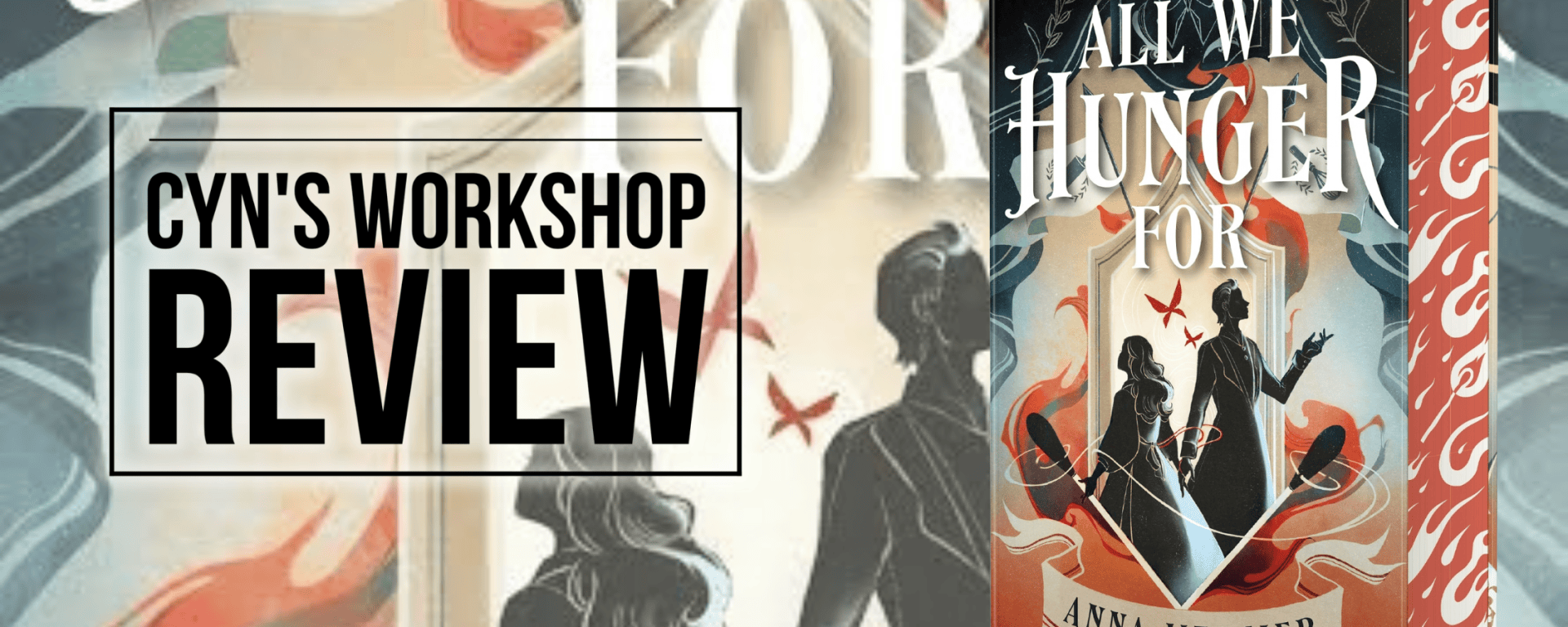
All We Hunger For combines the irresistible fun of a magical baking competition with revolution, class inequality, complex characters, and a beautifully developed romance.
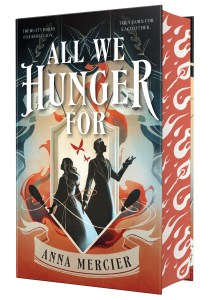
If you love fantasy, revolutionary politics, and The Great British Bake Off, let me introduce you to All We Hunger For by Anna Mercier.
Yes, you read that correctly.
We have revolution.
We have magic.
We have class inequality.
And we have a magical baking competition.
The publisher sent me an ARC of this one, and I ended up loving it so much that I’m probably going to buy a finished copy when it releases. The baking competition immediately appealed to me, but what really impressed me was how Mercier uses it to explore much larger themes surrounding privilege, poverty, equality, and revolution.
It was fun, romantic, magical, and far more thoughtful than I initially expected.
Welcome to the Magical Great British Bake Off
The central premise immediately hooked me.
In this world, the leaders of the different arts hold positions on the governing council. When the culinary seat becomes vacant, a competition is held to determine who will fill it.
Basically, magical Great British Bake Off with considerably higher stakes.
Enter Rousseau.
Rousseau comes from the impoverished side of society, and her family name carries some serious baggage. Her mother helped lead a failed rebellion against the ruling class, leaving Russo associated with a revolutionary movement that the people in power would rather forget.
So when her ex-boyfriend, now involved with the new underground revolutionary movement, gives her another identity and asks her to enter the competition as part of their plans, Rousseau isn’t exactly supposed to become invested in winning.
There’s just one little problem.
She’s really freaking good at baking.
Rousseau Isn’t Supposed to Win
Initially, Rousseau’s role in the competition is strategic.
She’s supposed to provide a distraction.
Instead, she earns herself an actual place among the competitors.
Suddenly, the woman who entered under a false identity and absolutely cannot afford to draw too much attention to herself is doing exactly that.
I loved this setup because it immediately creates tension between Rousseau’s obligations to the revolution and something she genuinely loves doing.
Baking isn’t simply a tool for her.
It’s an art.
And Rousseau is incredibly talented at combining food with magic.
The further she progresses, the more the competition becomes something she wants for herself rather than simply another part of someone else’s plan.
Baking Becomes Its Own Kind of Magic
This was easily one of my favorite parts of the book.
Mercier doesn’t simply tell us that Rousseau is talented. We actually get to experience her thought process as she creates each dish.
She considers flavors, ingredients, balance, presentation, and, most importantly, intent.
Because in this world, food can carry magic.
That creates some fantastic scenes where baking becomes an extension of Russo’s emotions and beliefs.
One challenge in particular stood out to me when Rousseau magically imbues her food with the sensation of starvation.
For the privileged people judging her food, it’s an experience.
For the impoverished people living across the river, it’s everyday life.
And the cure is something as simple as a glass of milk.
That scene encapsulates so much of what the book is trying to accomplish.
Rousseau isn’t simply feeding the judges.
She’s forcing them to experience something they have the privilege of ignoring.
Revolution Baked Into the Story
That’s where All We Hunger For becomes much more than a cute fantasy about a magical baking competition.
The revolutionary themes are woven directly into the competition itself.
Rousseau’s mother fought for change and failed. Rousseau has grown up carrying the consequences of that failure, and she’s understandably reluctant to become another revolutionary.
Nik isn’t exactly eager to tear society apart either.
But the longer both characters spend confronting the inequalities built into their world, the harder it becomes for them to ignore the need for change.
I appreciated that neither character begins as a perfect revolutionary hero.
Their beliefs evolve.
They question things.
And gradually, they begin understanding that remaining outside the conflict doesn’t mean the conflict isn’t affecting them.
Lafontaine and the Illusion of Equality
Lafontaine was one of the more interesting characters because, initially, you can almost convince yourself that maybe he has a point.
Almost.
He’s very good at presenting himself as someone interested in equality.
But his version of equality isn’t actually about dismantling the systems keeping impoverished people powerless.
Instead, he wants to remove magic entirely.
If nobody possesses magic, then everyone is supposedly equal.
Except that’s not how equality works when the economic and political systems creating inequality remain intact.
Taking away everyone’s magic doesn’t suddenly feed people who are starving.
It doesn’t redistribute power.
It doesn’t undo generations of inequality.
It simply creates the appearance of an even playing field without addressing why that field was unequal in the first place.
I loved that distinction.
Nik Has Something to Prove
Nik Dupont also became one of my favorite parts of the story.
As Lafontaine’s illegitimate son, Nik has spent much of his life trying to prove himself to a father who doesn’t particularly value his magical ability.
Nik’s magic revolves around art and architecture.
And honestly?
It’s beautiful.
His father may consider that magic undesirable, but the story allows us to see its value through Nik.
That also creates an interesting emotional foundation for his character because so much of his identity has been shaped by seeking validation from someone who continually makes him feel inadequate.
Watching Nik gradually confront those expectations and decide what he believes rather than what his father expects from him gave him some excellent character development.
Rousseau and Nik’s Relationship Actually Works
I also really liked the romance.
And as someone who doesn’t usually read fantasy specifically for romance, that’s saying something.
Rousseau and Nik don’t immediately fall into one another’s arms.
They poke at each other.
They irritate each other.
They challenge each other.
Their relationship starts with friction before gradually evolving into friendship, trust, and eventually love.
That progression made the romance feel earned.
There are also some major revelations throughout the novel that complicate their relationship, and several times I found myself wondering how these two were possibly going to move forward.
But they continually find their way back to one another.
More importantly, they become a genuine support system.
Their relationship isn’t simply attraction. They’re breaking down each other’s emotional walls while simultaneously figuring out who they want to become.
Complex Characters Make Everything Better
I love complicated characters, and All We Hunger For gives its characters plenty of emotional baggage.
Rousseau isn’t simply the daughter of a revolutionary.
Nik isn’t simply the privileged son of an influential man.
Their backgrounds influence them, but they aren’t entirely defined by those backgrounds.
Both characters have complicated relationships with power, responsibility, family, and the revolution happening around them.
And neither starts the story desperately wanting to become some heroic figure fighting for change.
That makes their eventual growth much more compelling.
They have to reach those conclusions themselves.
The Plot Twists Kept Me Guessing
There are also several revelations I genuinely didn’t see coming.
Some of those twists significantly alter the relationships between the characters, and I appreciated that Mercier doesn’t use them simply for shock value.
They matter emotionally.
They force Rousseau and Nik to reevaluate what they know about each other and the people surrounding them.
More importantly, those revelations test the relationship the novel has spent so much time developing.
Instead of relying entirely on external conflict, the story makes its biggest twists personal.
That worked incredibly well for me.
But Seriously, Let’s Talk About the Food
I cannot finish this review without returning to the baking.
I love cooking competitions.
Give me MasterChef. Give me Hell’s Kitchen. Give me The Great British Bake Off. Put me in a hotel with Food Network and I’m happy.
So naturally, I was living for this competition.
I loved seeing how Rousseau approached each challenge, how she thought about flavor combinations, and how magic affected the finished creations.
The food isn’t simply window dressing.
Every bake tells us something about Rousseau.
Sometimes she’s trying to win.
Sometimes she’s making a statement.
Sometimes she’s communicating through the only medium available to her.
That made the competition feel integral to both her characterization and the larger story.
Final Thoughts
All We Hunger For was such a fun read.
Anna Mercier takes the irresistible premise of a magical baking competition and builds a surprisingly layered fantasy around it, exploring revolution, poverty, privilege, inequality, family expectations, and what meaningful social change actually requires.
The baking competition is absolutely what initially hooked me, but Rousseau and Nik are what made the story work.
They’re complex characters who challenge one another, slowly break through each other’s defenses, and gradually develop a relationship that feels earned. Their romance never overwhelms the larger story, and their individual growth remains just as important as their feelings for each other.
I also loved how seamlessly the revolutionary themes were incorporated into the competition. Rousseau’s magic allows her food to become a form of expression, protest, and resistance, giving the baking real narrative importance beyond simply determining who wins.
It’s magical.
It’s romantic.
It’s political.
It’s full of delicious food.
And most importantly, it was just incredibly fun to read.
I enjoyed this ARC enough that I want a finished copy sitting on my shelf, which is probably one of the best compliments I can give a book.
Highly recommended.