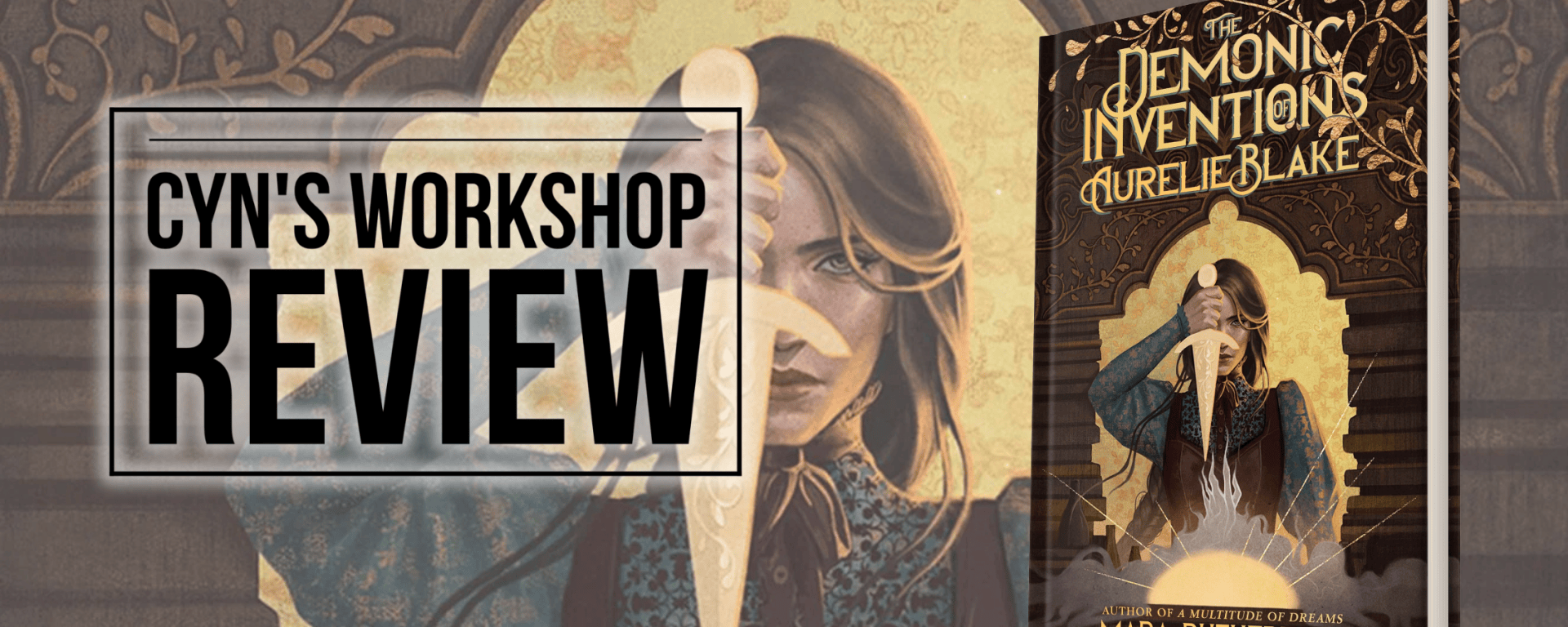
The Demonic Inventions of Aurelie Blake delivers an inventive fantasy adventure filled with dangerous magic, hilarious enemies-to-lovers banter, lovable characters, and a fascinating exploration of the consequences of innovation.
Sometimes you pick up a fantasy novel expecting one thing and end up getting something completely different. That’s exactly what happened when I read The Demonic Inventions of Aurelie Blake by Mara Rutherford. I wasn’t entirely sure what to expect, especially considering my previous experience with the author’s writing, but I certainly wasn’t prepared for just how much fun this book would be.
I’ve previously read Rutherford’s A Multitude of Dreams, a gothic fantasy inspired by Edgar Allan Poe’s The Masque of the Red Death. I enjoyed that novel, particularly its exploration of antisemitism and how it incorporated real-world prejudice into a fantasy setting. However, its gothic atmosphere and slower, more deliberate pacing made it a somewhat dry reading experience, which I recognize isn’t going to appeal to everyone.
The Demonic Inventions of Aurelie Blake, on the other hand, is an entirely different experience. It’s imaginative, fast-paced, surprisingly humorous, and filled with characters whose interactions kept me entertained from beginning to end. While I could still recognize certain elements of Rutherford’s storytelling, this novel demonstrated a lighter, more playful side of her writing that I hadn’t encountered before.
And honestly? I loved it.
A Fantasy World Where Every Invention Creates a Demon

The premise of The Demonic Inventions of Aurelie Blake is easily one of the most fascinating fantasy concepts I’ve encountered recently.
In this world, creating something new comes with a terrifying consequence: every invention brings a demon into existence. It doesn’t matter whether the invention is something extraordinary or an incredibly simple solution to an everyday problem. If someone creates something genuinely new, a demon manifests.
And these demons can be deadly.
One example that particularly stood out to me involved a man trying to solve a problem with contaminated drinking water. The village well had become unusable, so he developed a simple filtration system to make the water safe to drink.
He wasn’t trying to revolutionize society or challenge the established order. He was simply attempting to solve a problem that affected his community.
Unfortunately, his invention resulted in the appearance of a massive demon that killed people.
I thought this was a brilliant way to establish the stakes because it immediately demonstrates how complicated innovation becomes when even the most well-intentioned inventions can have devastating consequences.
The premise also creates a fascinating moral dilemma. If people need to invent new things to survive and improve their lives, but doing so places others in danger, how do you determine whether innovation is worth the risk?
And that’s where the novel becomes considerably more interesting than its whimsical premise might initially suggest.
Innovation, Fear, and the Dangers of Progress
One of my favorite aspects of the novel was the discussion surrounding innovation and how societies respond to change.
The concept reminded me of historical periods when people who challenged established beliefs or introduced unfamiliar ideas were treated with suspicion. Throughout history, individuals who questioned accepted practices or pursued unconventional knowledge have sometimes been accused of witchcraft, heresy, or other forms of wrongdoing.
Rutherford takes that fear of innovation and gives it a literal supernatural consequence.
In this world, people aren’t simply afraid of change because it challenges tradition. They’re afraid because inventing something new can actually summon a monster capable of killing them.
I thought that was an incredibly clever foundation for a fantasy novel because it allows the author to explore the relationship between progress and responsibility.
Innovation isn’t inherently good or evil. Sometimes people create things because they genuinely want to improve the world, while other inventions can be used for destructive purposes.
The important question becomes whether the dangers associated with innovation justify preventing progress altogether.
And the two main characters approach that question from completely different perspectives.
Aurelie Blake: An Inventor Who Refuses to Stop Creating
Aurelie Blake was an absolutely delightful protagonist.
She’s intelligent, inventive, curious, and so completely absorbed in her work that she occasionally forgets to pay attention to the world around her. Her mind seems to be moving a million miles a minute, constantly searching for new ideas and possibilities.
Naturally, that makes her a little absent-minded.
She’s also somewhat clumsy, frequently getting herself into situations because she’s too focused on whatever she’s thinking about to notice what’s happening around her.
I found that incredibly charming because her personality felt like a natural extension of her passion for invention. She’s not oblivious because the author wants her to appear quirky. She’s genuinely so fascinated by her work that everything else occasionally becomes secondary.
And honestly, I could relate to that.
I also appreciated that Aurelie doesn’t view invention as something inherently dangerous or immoral. She recognizes the risks involved, but she believes that creating new things is an essential part of improving people’s lives.
That conviction becomes especially important when she encounters someone whose entire worldview is built around preventing the very thing she loves most.
Destrier: A Demon Hunter with a Tragic Past
Enter Destrier, a member of the Iron Guard who has dedicated his life to protecting people from demons.
Unlike Aurelie, Destrier believes that invention is reckless and dangerous. From his perspective, people who create new things are knowingly placing others at risk, and he struggles to understand why anyone would continue inventing when the consequences can be so devastating.
But his beliefs aren’t simply the result of stubbornness.
Destrier lost his parents to demons when he was very young, leaving him orphaned before he ever had the opportunity to truly know them. The Iron Guard became his family, and its beliefs about protecting society from the dangers of invention shaped his entire upbringing.
I thought that backstory was incredibly important because it gives his worldview an understandable emotional foundation.
He’s not opposed to innovation simply because he’s resistant to change. He’s afraid of what invention can unleash because he’s already experienced that devastation firsthand.
And when you’ve spent your entire life believing that invention is responsible for destroying your family, it’s understandable that you might view inventors with suspicion.
Of course, that makes his relationship with Aurelie particularly entertaining.
Aurelie and Destrier Have Fantastic Banter
The dynamic between Aurelie and Destrier was easily one of my favorite parts of the novel.
These two do not particularly like each other when they first meet, and their conflicting personalities create some absolutely fantastic interactions.
Aurelie is curious, independent, and constantly thinking about her next invention, while Destrier is disciplined, cautious, and deeply suspicious of anyone who might accidentally summon a demon.
Naturally, Aurelie finds plenty of opportunities to irritate him.
She even enjoys calling him “Destroyer,” which I thought was hilarious because it perfectly captures her teasing personality and their relationship.
Their initial encounter also establishes their differences beautifully. Aurelie leaves a social gathering where she’s expected to entertain the attention of a potential suitor who has little interest in her intelligence or ideas. Rather than continue participating in a situation where she isn’t being taken seriously, she decides to leave and visit a pub.
Unfortunately, she’s being followed by a demon, and Destrier finds the entire situation suspicious.
From there, their interactions become an entertaining mixture of irritation, distrust, reluctant cooperation, and increasingly complicated feelings.
I loved every minute of it.
Enemies-to-Lovers Romance That Actually Develops
One of the reasons Aurelie and Destrier’s relationship worked so well for me was that their romantic development was closely connected to their individual character growth.
They don’t simply dislike each other because the story needs an enemies-to-lovers romance. Their conflict comes from genuinely opposing beliefs about invention and responsibility.
Aurelie believes innovation is necessary, while Destrier sees it as a dangerous practice that has already destroyed countless lives.
Neither perspective is entirely unreasonable.
As the story progresses, however, they begin to understand why the other person feels the way they do. Destrier gradually recognizes that inventors aren’t necessarily careless or malicious. Sometimes people create new things because they’re trying to solve problems, protect their communities, or improve their circumstances.
Likewise, Aurelie begins to recognize that not every demon is harmless and that some people are willing to exploit invention for dangerous purposes.
I appreciated that their developing relationship encourages both characters to question their assumptions without completely abandoning their individual identities.
They grow to understand each other, and that understanding gradually develops into attraction and affection.
And the romantic tension between them is adorable.
Dual POV Makes Their Character Development Shine
Another aspect of the novel I particularly enjoyed was the dual perspective.
By following both Aurelie and Destrier, readers get to understand their individual motivations and how their experiences influence their behavior.
I think this was especially important because their beliefs are so fundamentally different. If the story had been told entirely from Aurelie’s perspective, Destrier might have seemed unnecessarily rigid or judgmental. Likewise, experiencing everything through Destrier’s eyes could have made Aurelie appear reckless.
Instead, Rutherford allows readers to understand both sides of the conflict.
We see why Destrier fears invention and why Aurelie believes that suppressing creativity is not the answer.
That balance makes their character development considerably more meaningful because neither character has to become completely different for their relationship to work.
They simply have to learn that the world is more complicated than their individual experiences have led them to believe.
A Surprisingly Funny Fantasy Adventure
One of the biggest surprises for me was the humor.
I hadn’t experienced this particular side of Rutherford’s writing before, especially after reading the considerably darker and more atmospheric A Multitude of Dreams.
But The Demonic Inventions of Aurelie Blake is genuinely funny.
Much of that humor comes from Aurelie’s personality and her interactions with Destrier. Her teasing, absent-mindedness, and tendency to become completely absorbed in her inventions create some wonderful moments.
Destrier’s more serious personality makes him the perfect contrast because his reactions to Aurelie are often just as entertaining as her behavior.
I loved how naturally the humor emerged from their characterization rather than feeling like jokes inserted simply to lighten the atmosphere.
The banter is fantastic, the romantic tension is charming, and their increasingly flustered interactions made me smile throughout the novel.
Considering how dark the premise can be, that balance between humor and danger was particularly effective.
The Most Adorable Little Demon
Can we please talk about Aurelie’s pet demon?
Because I absolutely adored that little creature.
Despite living in a world where demons are generally considered dangerous monsters, Aurelie has managed to develop a genuine attachment to a small, strange, spider-like demon that she cares for.
And he’s precious.
I kept picturing a demonic version of Rocky from Project Hail Mary, which probably made me love him even more.
There’s something incredibly charming about a character who lives in a society terrified of demons but still manages to see something worth protecting in one of them.
I also appreciated how Aurelie’s relationship with her little companion reinforces the novel’s larger themes.
Just because something is labeled dangerous doesn’t necessarily mean every individual creature deserves to be feared or destroyed.
And just because a demon exists as the consequence of an invention doesn’t automatically mean it lacks the capacity to be something other than monstrous.
That little demon must be protected at all costs.
I don’t care what anyone says.
A College Built to Contain Dangerous Inventions
Another detail I enjoyed was the way society has adapted to the dangers of invention.
Rather than completely eliminating education or preventing people from exploring new ideas, the world has developed precautions intended to contain the consequences of innovation.
The college Aurelie attends is surrounded by iron gates designed to protect people if an invention summons a demon.
There are also protective measures, such as salt circles, that inventors can use when experimenting.
I thought those details were particularly interesting because they demonstrate that invention isn’t necessarily prohibited in every circumstance. Instead, society has developed systems intended to manage the risks.
Aurelie herself is generally careful about her experiments, which reinforces the idea that inventors aren’t automatically irresponsible simply because they’re willing to create something new.
That distinction becomes important throughout the story because the central conflict isn’t simply about whether invention is dangerous.
It’s about whether the potential benefits justify the risks and whether society can find a way to embrace progress without sacrificing people’s safety.
When Good Intentions Become Dangerous
As the story develops, Aurelie becomes involved in a project that she believes could potentially end the curse affecting her country.
The idea is incredibly tempting because a world where invention no longer summons demons would fundamentally change society.
People could create new technologies, solve problems, and improve their lives without constantly fearing that their ideas might unleash something deadly.
Unfortunately, the person who recruits Aurelie has considerably more sinister intentions.
The project involves creating a portal, and Aurelie gradually discovers that the situation is far more dangerous than she initially understood.
I thought this was an excellent way to develop the novel’s central themes because it forces Aurelie to confront the possibility that innovation can be manipulated for destructive purposes.
She’s not wrong to believe that invention can improve people’s lives, but she has to recognize that good intentions don’t guarantee good outcomes.
Likewise, Destrier begins to understand that preventing invention altogether isn’t necessarily the solution.
Both characters are forced to reconsider their beliefs, and that development makes the larger conflict considerably more compelling.
The Pacing Was Excellent
One of the reasons I enjoyed The Demonic Inventions of Aurelie Blake so much was the pacing.
Compared to A Multitude of Dreams, this novel feels considerably faster and more energetic. The story moves confidently between character development, romantic tension, dangerous inventions, and the larger mystery surrounding the curse.
I never felt like the plot was dragging or that the author was spending too much time on unnecessary details.
Even the quieter moments between Aurelie and Destrier contribute to the larger narrative because they allow their relationship and individual perspectives to develop.
I also appreciated how the humor helped balance the darker elements of the story. The premise involves deadly demons and a society terrified of innovation, but the novel never becomes overwhelmingly bleak.
Instead, Rutherford creates a fantasy adventure that feels entertaining and imaginative while still exploring meaningful questions about responsibility and progress.
That balance made the book incredibly difficult to put down.
That Cliffhanger Was Absolutely Cruel
And then we have the ending.
Mara Rutherford, what was that?
Seriously.
I was having such a wonderful time with this book, enjoying the characters, the humor, and the increasingly complicated mystery, only for the ending to leave me completely stunned.
And now I have to wait for the sequel.
Wonderful.
I was so frustrated that I actually reached out to the author on Instagram to express my feelings about that cliffhanger. Thankfully, she seemed to find my reaction amusing, which made the entire exchange even more entertaining.
But I’m still not over it.
I need to know what happens next, especially after everything Aurelie and Destrier experience throughout the novel.
And I sincerely hope the second book maintains the humor that made this installment so enjoyable.
Considering how things ended, I’m a little concerned about how much emotional damage we’re going to experience in the sequel.
Please, Mara. Let us have some happiness.
Why This Book Surprised Me
What impressed me most about The Demonic Inventions of Aurelie Blake was how different it felt from my previous experience with Rutherford’s writing.
I enjoyed A Multitude of Dreams, particularly its gothic atmosphere and exploration of prejudice, but its slower pacing made it a very different reading experience.
This novel, however, feels more adventurous and playful.
The humor, character dynamics, and imaginative magical system give it an energy that I wasn’t expecting, especially considering the darker premise.
I also loved that the novel offered more than simply an entertaining fantasy adventure. The discussion surrounding invention, progress, and responsibility provides plenty of opportunities for deeper analysis.
Is innovation inherently dangerous, or does the danger come from how people use what they create? Should society prevent progress because of its potential consequences, or should people find ways to minimize those risks?
Those are fascinating questions, and I appreciated that Rutherford incorporated them into the narrative without sacrificing the humor or pacing.
Final Thoughts
The Demonic Inventions of Aurelie Blake by Mara Rutherford was an incredibly entertaining fantasy adventure that completely exceeded my expectations.
I loved the imaginative premise of a world where every invention summons a demon, particularly how that concept creates meaningful discussions about innovation, responsibility, and society’s fear of change.
Aurelie and Destrier were fantastic protagonists whose opposing beliefs made their enemies-to-lovers romance especially compelling. Their banter was hilarious, their character development felt natural, and I appreciated how the dual POV allowed readers to understand both sides of their conflict.
I was also pleasantly surprised by the humor. Rutherford balances the darker elements of the story with playful interactions and genuinely charming moments, creating a reading experience that feels considerably lighter and more energetic than her gothic fantasy A Multitude of Dreams.
And of course, I absolutely adored Aurelie’s little pet demon. That creature deserves nothing but happiness and protection, and I will not be accepting arguments to the contrary.
The pacing was excellent, the worldbuilding was imaginative, and the larger mystery surrounding the curse kept me invested from beginning to end.
My only complaint?
That ending.
I need book two immediately because I am not emotionally prepared to wait after that cliffhanger.
Ultimately, this was a fantastic read that reminded me why I love discovering different sides of an author’s storytelling. The Demonic Inventions of Aurelie Blake is clever, funny, romantic, and filled with fascinating ideas about the relationship between invention and danger.
Highly recommended, and I cannot wait to see what happens next.