


Another great mythological retelling that focuses on the women of the Iliad in Troy and highlights their struggle amongst men.
Jennifer Saint once again astounds with Elektra, delving into her relationships not only with her father Agamemnon but also with her mother Clytemnestra, and even her brief encounter with Cassandra.
Storytelling
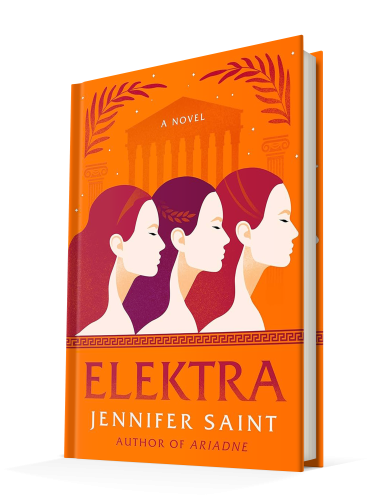
As much as I liked Elektra, I unfortunately did not love it as much as I did Ariadne.
My biggest problem with this book was that we didn’t really get to see and understand Elektra’s relationship with her father, Agamemnon.
There is one brief scene when we’re first introduced to Elektra and Agamemnon. Her father gives her a dagger shortly before the war of Troy begins, and after that, she doesn’t see him again.
The rest of the story focuses on Elektra’s confusion about why her mother, Clytemnestra, hates Agamemnon so much. Her older sister is dead, and Elektra rationalizes this by thinking that her father had to sacrifice her sister to ensure a favorable wind that would bring honor back to their family. I wanted more depth in this area. I would have liked to have seen a bit more of Elektra’s relationship with her father, Agamemnon, because we only get that one scene. It didn’t provide enough context to understand why she was so loyal to him or why she was determined to stand by him.
In contrast, we learn why Clytemnestra turned against Agamemnon; we see her feelings of betrayal regarding his actions. Clytemnestra’s anger—as a mother, wife, and woman—resonated with me as a reader. I completely empathized with her, and I really believe the story itself should have been titled Clytemnestra instead of Elektra. We gained much more insight into Clytemnestra’s perspective than we did into Elektra’s or Cassandra’s.
Another issue I had with this book was Cassandra’s perspective. While I appreciated her viewpoint and wanted more of it, it felt unnecessary within a story titled Elektra, as Elektra has very little interaction with Cassandra. If the story had been titled Clytemnestra, then Cassandra’s perspective would have fit better. There’s a particular scene where Cassandra and Clytemnestra meet; it’s significant because Cassandra knows she will die by Clytemnestra’s hand. During that encounter, an understanding passes between the two women: Clytemnestra is no longer the villain who kills her husband’s slave or mistress. Instead, she is saving Cassandra from slavery and torture—a cruel life.
I liked that moment, but again, it feels unnecessary considering the focus was supposed to be on Elektra. Ultimately, I feel we didn’t understand Elektra’s devotion and loyalty to her father as much as I would have liked. From the beginning, she shows no understanding or empathy towards her mother. Instead, she is headstrong and insists on being loyal to her father. I would have liked more development in this area so that I could connect with her better.
Final Thoughts
Elektra is a great book. Jennifer Saint masterfully transforms traditionally villainous characters into relatable figures, evoking empathy and creating a strong connection between the reader and these mythological characters.




Donate with Paypal
Help Cyn’s Workshop improve and grow with a one-time donation. Donations go towards equipment, writing suppliments and giveaways to the bookish community.
$1.00